3c认证
Restoration brings endangered egrets to China’s Yellow Sea coast_我的网站

一 |
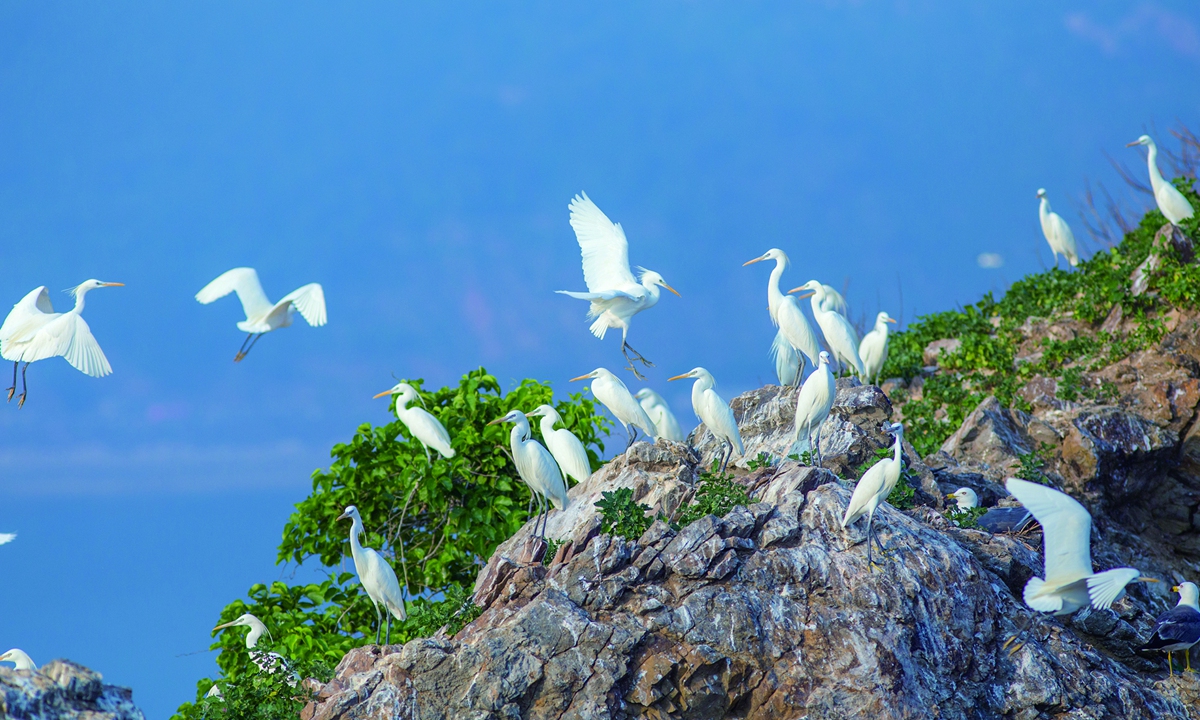
A group of Chinese egrets on Fantuozi Island in Dalian, Northeast China's Liaoning Province Photo: Courtesy of Changhai County People's Government
At 5 am, Wang Piyu, deputy director of the Changhai County Natural Resources Affairs Service Center, sets out by patrol boat for Fantuozi Island, a core breeding site for Chinese egrets in the Changshan Archipelago, Northeast China's Liaoning Province. The island has no permanent residents.
About 100 meters from the island, Wang turns off the engine and reminds accompanying researchers to keep their voices low to avoid disturbing the nesting birds.
Stepping onto the island, they walk along paths covered with vines. Scattered across the rocky slopes are nests measuring 40 to 50 centimeters in diameter. Inside, fluffy chicks huddle together among soft grass woven into nests, while adult birds perch high in the trees, watching cautiously.
"This was not what the island looked like 10 years ago," Wang recalled. "People used to collect eggs here, and coastal aquaculture polluted the tidal flats. Many parts of the island were bare, leaving little vegetation for birds to nest."
The recovery of Changshan Archipelago, however, has turned the remote archipelago into an important link in global conservation efforts.
At the 48th session of the UNESCO World Heritage Committee in Busan, South Korea, the boundary modification of the Migratory Bird Sanctuaries along the Coast of Yellow Sea-Bohai Gulf of China was approved, officially adding the Changshan Archipelago to the World Heritage site.
The expansion further strengthens the integrity of the serial natural heritage site, following a previous update in 2024, and highlights China's efforts to integrate coastal ecosystem conservation, according to the National Forestry and Grassland Administration.
Behind the World Heritage recognition lies years of conservation work involving local authorities and island residents.

An aerial view of Changshan Archipelago in Liaoning Province Photo: VCG
Building a bird havenLocated in the northern Yellow Sea off Dalian, the Changshan Archipelago sits along a key route of the East Asian-Australasian Flyway, providing an essential stopover where tens of millions of migratory birds replenish their energy during their journeys across the Bohai Sea.
The newly added area covers more than 4,900 hectares and is home to more than 140 recorded bird species, including the Chinese egret and black-faced spoonbill, both listed as China's national first-class protected animals.
In 2015, more than 300 Chinese egrets arrived in Changhai county. After discovering the birds, local authorities introduced a series of protective measures, including establishing patrol teams and installing remote monitoring systems to reduce human disturbance.
However, the growing bird population also created new challenges.
Less than half of Fantuozi Island was covered by shrubs, which serve as the nesting grounds for the egrets. Additionally, the island's poor soil and acidification caused by years of accumulated bird droppings had led to the withering and death of some shrubs in recent years.
From 2022, the county launched an ecological restoration project, replacing surface soil with fertile earth and planting more than 2,200 shrubs.
The efforts helped restore the breeding habitat. The number of Chinese egrets on the island has since recovered, with this year's population estimated at about 3,500, including around 1,500 adults and nearly 2,000 chicks, according to Lü Yongquan, director of Changhai county's natural resources bureau.
"Chinese egrets are highly sensitive to water quality, vegetation and human disturbance. Their return to breed here is a sign that the marine ecosystem has recovered and is thriving," Lü told the Global Times.
From fishermen to guardiansConservation in Changhai is not only carried out by authorities. Local communities have also gradually become part of the protection network.
Authorities have expanded public awareness campaigns and strengthened patrols. Because most of the Changshan Archipelago is uninhabited, drones, fixed-point infrared cameras, and on-site inspections are used to monitor the islands and reefs around the clock.
Many fishermen who once relied on the sea for their livelihoods now help protect it.
During the peak breeding season from April to July, regular marine patrols are carried out to protect nesting sites and prevent illegal egg collection and habitat damage. Local bird conservation groups and research institutions have also joined the efforts, while fishermen have taken on new roles as volunteer guardians of the islands.
Across Changhai county, many fishermen now actively participate in coastal patrols to help protect the archipelago's biodiversity.
For Li Qingsen, a 50-year-old island native and member of the county's forest fire brigade, protecting the birds has become a way of life.
From spring to autumn, 20 team members take turns staying on Fantuozi Island in pairs to protect the birds from disturbance.
Life on the 0.08-square-kilometer island is far from easy. There are no freshwater sources or docks. Patrol workers carry large barrels of water and wade ashore from boats anchored offshore. Instant noodles are often their main food because they require little preparation and some water.
Their work is closely tied to the seasonal cycle of the birds. Each April, thousands of Chinese egrets arrive in the archipelago from Southeast Asia to breed and rear their young, staying until early September before migrating south for the winter.
At present, young egrets are already practicing flight above the treetops. By autumn, they will join their parents in a southward migration.
For Wang, who has spent half of his life guarding Fantuozi Island, the World Heritage recognition is both a homecoming for the birds and a reward for years of protection. "Now, it is a home for the birds, and a reward for all the years we have spent protecting it."
。

二 |
原标题:9.9元买新手机,老机型免费换电池,魅族这用户关怀绝了大家有想过用了几年的手机还能官方免费换电池吗?这事还真的有。

三 | 我们熟悉的国产手机厂商魅族,之前就曾推出了一个「产品焕新计划:免费换电池」,根据不同机型的用户需求分批推出更换电池服务,让老机型也能焕发生机,可谓是将“钉子户”宠上天。(「产品焕新计划:免费换电池」第三批参与免费焕新电池的机型)而继之前的首批机型魅族 15、魅族 15 Plus、魅族 Note 8、魅蓝 Note 5、魅蓝 S6,以及第二批机型魅族 17 和魅族 17 Pro 之后,最近魅族也是继续公布了「产品焕新计划:免费换电池」第三批参与免费焕新电池的机型,它们分别是魅族 16th、魅族16s,和魅族 16s Pro。

四 | 从9月13日起,魅族官方客服将会按机型登记顺序分批次联系大家安排电池免费焕新,所以各位魅友们记得要保持电话畅通了。

五 | (魅族 M8)其实,魅族对于用户关怀的重视,从它刚开始入局智能手机市场时就已经有所体现。当时魅族推出了国内第一款大屏幕全触屏智能机魅族 M8,仅仅两个月,销量就达到了10万部,仅5个月销售额便突破了5亿元,让魅族开始声名鹊起。正是在那时候,魅族也正式拉开了国内厂商“卷用户关怀”的序幕,当时魅族不仅推出了非人为因素硬件故障一年包换的用户关怀政策,还为购买了魅族 M8 的用户免费赠送当时价值158元的充电套装,里面含有一块魅族 M8 标配电池,以及一个魅族 M8 电池盒(可连接USB线为电池充电),让用户从那时候起就享受到免费电池的福利,直到现在都没变,是行业唯一一个持续坚持为老用户免费换电池的科技公司,可以说是名副其实的“卷王”了。(魅族 18s Pro、魅族 18 Pro 实力备受肯定)魅族的“卷”还体现在产品上,从 M8 开始,魅族就在持续不断地为我们带来优秀的手机产品,像是如今的魅族 18 系列就是一个很好的例子,常常凭借出色的外观和配置斩获不少奖项。此前,魅族 18 Pro 就荣获了2022 iF 国际设计大奖,还有魅族 18s Pro 也获得过2021手机设计大赛天鹅奖之「年度最佳性能手机奖」,以及大众人气高端旗舰的Top 1,实力受到了大众的肯定。(魅友节)因此大家最近要是有打算换手机的话,不妨可以参与近期举行的 2022 魅友节,魅族为了我们带来了非常多的福利活动,包括了魅友服务周、海量商品每天 10 点 9.9 元限量秒杀、魅族商城惊喜福利。如果大家在活动期间购买魅族 18s 系列或魅族 18X 新机,可享18个月质保、官方碎屏保障服务5折优惠等,甚至还有机会 9.9 元秒杀魅族 18s、魅族 18X 等产品,大家不要错过了。返回搜狐,查看更多责任编辑:
。
Current article:http://jyfr.bianneixuanbingqinyouxie.buzz/14i/9rae2.html
Published on:04:33:40